
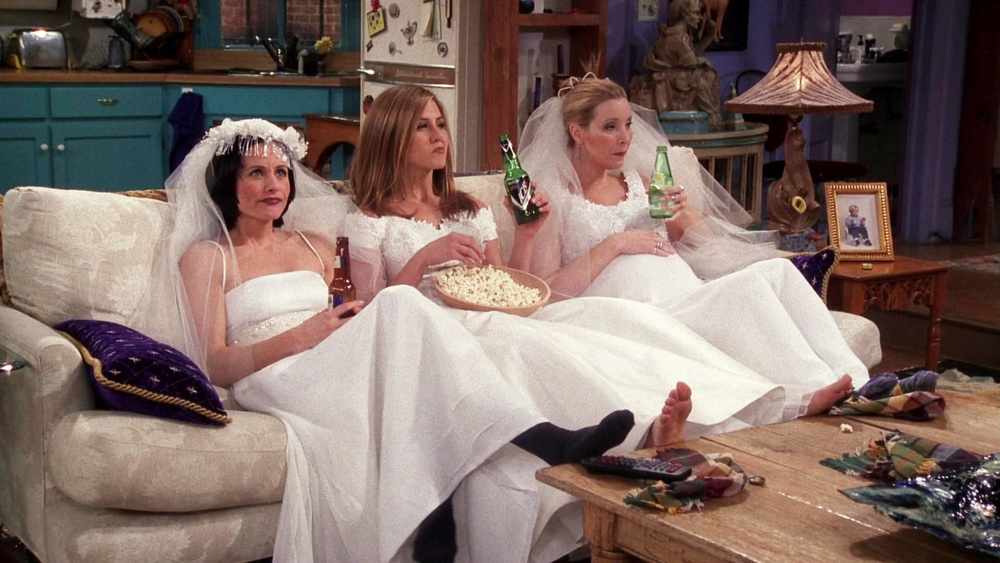
While Friends did make their lead female characters as complex and developed as the lead male characters, many stereotypes, social, and gender roles were still present. The men of the show often talked about women and sex-related topics. While the women often discuss fashion, men, and romance. In the journal, Constructing Gender Stereotypes Through Social Roles in Prime-Time Television Lauzen, Dozier and Horan discuss the stereotypical social roles men and women typically play in television. Though the journal uses programs airing in the 2005-2006 season, the same notions still applied during the time frame Friends initially aired. They specifically mentioned interpersonal and work roles. As stated in the journal, “the basic social roles assigned to female and male characters by storytellers are tremendously important contributors to the construction and maintenance of gender stereotypes.”
Social Roles
In
Constructing Gender Stereotypes Through Social Roles in Prime-Time Television
it states “notions of marriage, home, family and romance are important aspects
of the way characters are portrayed and tend to be much more developed in
female characters than male characters” (Lauzen et al). In Friends, the lead female characters were more focused on those
notions than the male characters. Marriage was an essential part of Rachel and
Monica’s lives. Monica especially discusses marriage, children and a family
multiple times. Many of her fantasies include her happiness in stereotypical
domestic duties Phoebe was notably not interested in marriage until the last
season. Ross was a male character who was very much interested in the idea of
marriage. However, he was married and divorced three times, making his failures
the butt of many jokes. Chandler was afraid of marriage and commitment, another
male stereotype, until the very last seasons. Joey was not interested in
commitment and was a womanizer throughout almost the entire series.
In the Workplace
The male leads had arguably more respected (and higher paying) jobs than their female counterparts. Ross was a paleontologist and university professor. Chandler worked as an executive in a large multi-national corporation. Joey was shown being not as well off financially but was an actor in a popular daytime soap opera. Rachel began as a spoiled rich girl, having her dad pay for everything. She then starts out as a waitress and later works in the fashion industry. Fashion is typically seen as trivial and women-dominated field in our society. Monica has multiple jobs in the food industry throughout the show. Her most prominent one was being a chef. Phoebe worked as a masseuse, also collecting money by playing music in the streets. Researchers found that female characters performed ‘‘more interpersonal/relational actions…and fewer decisional, political, and operational actions than do male characters.". In the episode ‘The One With Rachel's Assistant’ Rachel gets a promotion at Ralph Lauren. This episode also introduces her personal assistant, Tag. She hires him on his looks and begins to have a relationship with him. While she received a higher position in her career, it is focused more on her relationship.
Stereotypes
In the episode, ‘The One With The Male Nanny’
Ross and Rachel try to find a nanny for their daughter. Ross is surprised that
a man named Sandy applied for the job. He is the most qualified for the job out
of all the applicants. While Rachel is ready to hire him, Ross refuses as says
it is weird for a man to be a nanny. Ross also asks him if he is gay. Not only
is Sandy a name that could be taken as feminine, the character is also overly
emotional and exhibits qualities that society views as ‘feminine.’ This
reinforces gender stereotypes and the sex division of labor. This associates
showing emotion as a feminine quality and not considered masculine, causing the
idea that being overemotional makes a man homosexual. This episode shows
society views of taking care of children as ‘women’s work’ and men in that
field would be classified as weird.
.
In another episode ‘The One with the
Metaphorical Tunnel,’ Ross’ son Ben picks out a Barbie to play with. Ross is
upset seeing his son playing with a Barbie and tries to get him to play with
‘boy’s toy’ like a G.I. Joe, dinosaurs and a monster truck. Susan, one of Ben’s
mothers asks Ross if he’s afraid Ben is “gonna grow up to be in show business.”
This enforces the gender stereotypes of which toys children should play with,
leading into social roles. It also relates the idea of homosexuality by not
following the gender norms.
"Fat Monica"


